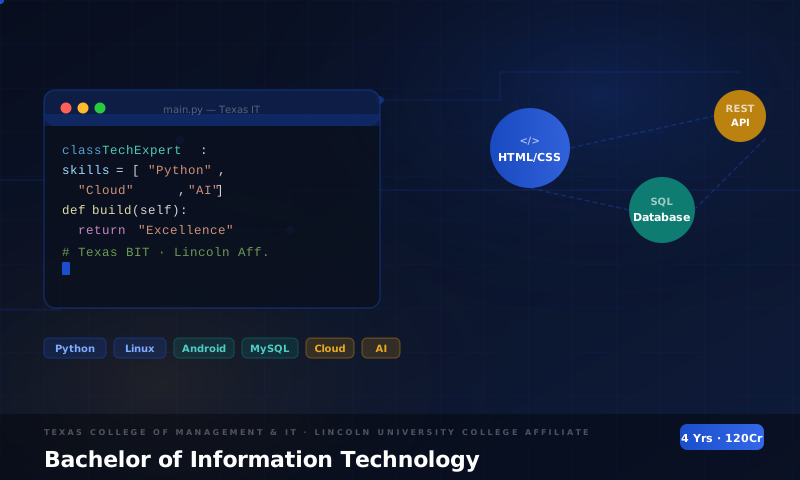



If you’re planning to pursue a Bachelor of Information Technology (BIT) in Nepal, understanding the eligibility requirements is the first step toward securing admission.
Students who have passed +2 or any other equivalent exam from a recognized board, with the required minimum GPA as set by their university of choice (usually 2.0 GPA or equivalent), have an equivalency certificate (if one is required), and pass the entrance exam (if applicable) will be eligible for a seat in BIT in Nepal.
This comprehensive guide explains everything you need to know about eligibility for BIT in Nepal, along with admission requirements in different universities, eligibility for students from different streams, examination requirements, required documents, and commonly asked questions.
Who Can Study BIT in Nepal?
You can apply for BIT in Nepal if you:
- Have completed +2 / NEB / A-Level / CBSE or equivalent degree
- Meet the minimum GPA or percentage required by the university
- Pass the entrance exam (if required)
- Hold a Nepal Equivalence Certificate for their qualifying qualification
Academic Qualification
The academic qualification that is required to study BIT in Nepal is:
- Completed +2 or equivalent
- Any Stream: Science, Management, Humanities, Arts, Hotel Management
Basic eligibility criteria at a glance
- Completed +2 or equivalent
- Minimum 2.0 GPA or Second Division (Depends on the university)
- Passing the entrance exam (if required)
- Nepal Equivalence Certificate
Minimum Eligibility Criteria for BIT Admission in Nepal

The eligibility criteria might slightly vary depending on the university you are trying to apply to, but the basic criteria remain the same in the context of BIT in Nepal.
Minimum Educational Eligibility (+2, A-Level, CBSE, NEB, or Equivalent)
Students must have completed +2 or equivalent education from a recognized institution. Applicants with foreign or international qualifications must provide a Nepal Equivalence Certificate for their qualifying qualification, where applicable.
Minimum GPA or Percentage Requirements
- Most universities require a 2.0 GPA or 50%
- Some private colleges might accept a lower percentage
Recognized Education Boards
Recognized Education Boards that are accepted include:
Minimum Age Limit
There is no age limit for BIT in most universities in Nepal.
University-Wise Eligibility for BIT in Nepal

Eligibility for BIT in Nepal may slightly vary depending on the university you choose. Different universities and affiliated colleges have their own admission criteria, which leads to minor differences in eligibility requirements. Below are the University-Wise Eligibility for BIT in Nepal:
Lincoln University College BIT Eligibility
- +2 or equivalent in any stream
- Minimum GPA varies (1.6 to 2.0)
- No entrance exam required
Tribhuvan University (TU) BIT Eligibility
- +2 or equivalent in any stream
- Minimum GPA set annually
- Mandatory entrance exam conducted by IOST (Institute of Science and Technology)
Purbanchal University (PU) BIT Eligibility
- +2 or equivalent
- Entrance exam or interview (College-based)
- GPA requirements vary by institution
Pokhara University (PoU) BIT Eligibility
- +2 with minimum GPA / percentage
- Some colleges require entrance tests
- Mathematics preferred, but not always compulsory
Other Universities Offering BIT in Nepal
- Kathmandu University has limited campuses offering BIT
- Foreign-affiliated universities have college-specific rules
University Eligibility Comparison Table
| University | Qualification | Entrance Exam | Math Required |
| TU | +2 / Equivalent | Yes | Preferred |
| Lincoln University | +2/Equivalent | No | Not Mandatory |
| PU | +2 / Equivalent | Yes | Not Mandatory |
| PoU | +2 / Equivalent | Yes | Not Mandatory |
Can Students from Different Streams Study BIT?
BIT in Nepal can be studied by students from different academic streams who meet the basic eligibility criteria set by the university. And this program is designed to be flexible and inclusive of various educational backgrounds.
BIT Eligibility for Science Students
Science students usually have a strong advantage compared to students from other streams, as they have a basic knowledge of mathematics, logical reasoning, and basic science subjects. So, they are easily eligible for BIT as they can adapt more easily to technical concepts, making them prepared for the BIT program.
BIT Eligibility for Management Students
Students who have a management background are also eligible to study BIT. Although they might not have a technical background. They are commonly accepted in most of the universities and colleges as long as they meet the minimum academic requirements.
BIT Eligibility for Humanities Students
Students with humanities as their stream are eligible for BIT in many private colleges and universities. They might face difficulties being eligible for public colleges and universities, especially if mathematics or technical subjects were not part of their +2 curriculum.
BIT Eligibility for Arts Students
Students with Arts as their stream might be eligible if they meet the minimum GPA criteria and entrance criteria. Eligibility also depends on the policies of the university or the college where they are applying for the BIT program.
Is Mathematics Compulsory for BIT in Nepal?

Well, Mathematics is not compulsory for everyone who is pursuing BIT in Nepal, but it may be compulsory for some universities and colleges for some students. Some schools require maths, others provide flexibility for non- science streams.
Universities That Require Mathematics
Many of the TU-affiliated colleges have mathematics as a mandatory subject, especially for entrance examinations. Some affiliated colleges prefer students who studied mathematics at the +2 level mainly because BIT includes subjects related to programming logic, and problem solving, where a basic mathematical foundation can prove to be helpful.
Universities That Accept Students Without Mathematics
Many PU-affiliated colleges accept students without mathematics in +2. These affiliated colleges focus more on overall performance, academic achievements, and entrance results rather than on a specific subject, which makes it accessible to students from streams such as management, Humanities, Arts, and Hotel Management.
What If You Didn’t Study Mathematics?
You don’t need to study mathematics in +2 to get admission in BIT in Nepal. Some offer “Basic mathematics” or foundation courses, and basic logical and computational training, as well as academic support in the first semester. Students who have not had any math classes can succeed in the BIT program with interest and study effort.
BIT Eligibility for A-Level, CBSE, and Foreign Board Students
If you have completed your A-Level, CBSE, or other foreign education, you can apply for the BIT program in Nepal. You must fulfill the required academic criteria set by the university and obtain an equivalency certificate recognized in Nepal to be eligible.
BIT Eligibility for A-Level
The criteria for an A-Level qualified student are:
- A minimum “D” grade in each subject
- NEB equivalency certificate
- A minimum grade in English and Mathematics/Computer Science
CBSE & ISC Board Eligibility
Students from CBSE or ISC boards are also eligible for BIT in Nepal. The criteria are:
- A minimum grade of 2.0 GPA or 45%-50%
- +2 completion
- NEB equivalency certificate
Admission decisions are based on academic performance and entrance results, depending on the university.
Foreign Qualification Equivalency Process
International or foreign-equivalent applicants must provide a Nepal Equivalence Certificate for their qualifying qualification for the admission process from the Curriculum Development Center (CDC).
Equivalency Process:
- Apply through Nepal’s official equivalency authority, CDC.
- Submit academic transcripts, certificates, and required documents
- Obtain equivalency before final admission confirmation
Without an equivalency certificate, admission to BIT programs in Nepal might not be possible, even if all other requirements are met.
Can CTEVT Diploma Students Apply for BIT?

Yes, CTEVT diploma students are eligible to apply for BIT in Nepal if they meet the minimum requirements set by the university and have an equivalency certificate.
CTEVT Diploma Programs eligible for BIT
Students who have completed three-year diploma programs under CTEVT can apply for BIT. Diploma in Computer Science or Information Technology and Diploma in Engineering are the CTEVT diploma programs that are eligible for BIT in Nepal.
Diploma in Engineering requirements
The requirements for a CTEVT Student with a Diploma in Engineering to apply for BIT education in Nepal are listed below:
- 3-year Diploma in Engineering from CTEVT.
- Mathematics and Computer Science are mandatory
- A minimum ‘C’ grade or a 2.0 CGPA (45% aggregate) across all subjects.
Equivalency Requirements for Diploma Holders
If you have a diploma from CTEVT, you can directly apply for the Bachelor of Information Technology if you meet all the requirements and processes. If you have a CTEVT diploma, it should be equivalent to an academic +2 qualification, and if you have a foreign diploma, you should get an equivalency certificate. The document needed for equivalency include original transcripts and degree certificates of your diploma, and the equivalency certificate if you have a foreign diploma.
Minimum GPA, Percentage, and Division Required for BIT
To apply for BIT in Nepal, students must meet the minimum academic requirements set by the university or affiliated college. These requirements are set using GPA, percentage, or division systems, depending on the education board you studied under.
Minimum GPA by University
PU (Purbanchal University), Kathmandu University, Gandaki University, and many other universities of Nepal require a minimum 2.0 CGPA, whereas Tribhuvan University and foreign-affiliated universities accept students with a minimum 1.8-2.0 CGPA.
Percentage-Based Eligibility
For a percentage-based grading system, BIT eligibility is usually 45% to 50%, depending on the university. With this grading system, overall academic performance is more focused than individual subject performance. The exact percentage might vary depending on the university or college.
Second Division vs GPA System
Both the division system and the GPA system are equally accepted for BIT admission in Nepal. In the division system, the second division is considered equivalent to 45% or above, or 2.0 GPA or higher. Students from the older examination system have a division-based system, whereas students from the newer board have a GPA system. Universities generally convert the grades internally to ensure fair evaluation of the different systems.
BIT Entrance Exam Eligibility

The entrance exam for enrollment into a BIT program depends on the university and affiliated colleges. The exam might be required to apply for BIT in some of the specific universities.
Is an Entrance Exam Mandatory?
Yes, an entrance exam is mandatory for universities like Tribhuvan University (TU), Kathmandu University (KU), Purbanchal University (PU), and others. But for foreign-affiliated universities, like Leeds Beckett University, University of Westminster, and others, it is not mandatory.
Who Can Appear for the Entrance Exam?
Students with a +2, A-level, CTEVT diploma, or an equivalent qualification with the minimum required grades can appear for the entrance examination.
Minimum Passing Marks
The minimum passing marks for the BIT entrance exam depend on the university. In most universities, students must score the minimum cutoff set by the institution, and admission is based on the overall ranking the students achieve in the entrance examination.
Entrance Exam Syllabus Overview
The syllabus of the entrance exam might vary depending on the university or the affiliated college, but the BIT entrance exam generally includes the following:
- Basic IT concepts
- Logical reasoning and analytical ability
- English comprehension and communication
- Basic Mathematics
Can Result-Waiting Students Apply for BIT?
Yes, result-waiting students are allowed to apply for BIT in Nepal at many colleges and universities. This policy helps students avoid losing an academic year while waiting for their final examination results.
Eligibility for Students Awaiting Results
Many colleges allow students who are awaiting their +2, A-Level, or equivalent results to apply for BIT and take part in the entrance examination on a provisional basis. However, students must have completed their examinations and must submit final results within the deadline set by the institution. If they fail to do so, then the admission can be put on hold. Final admission is granted only after meeting the minimum academic requirements.
Grade Improvement and Supplementary Exam Students
Students who are appearing in grade improvement or supplementary examinations are also eligible to apply for BIT under the provisional admission policies. Such students are usually required to provide proof of registration for improvement or supplementary exams and previous academic records, if requested. Admission remains provisional until updated results are officially submitted.
Provisional Admission Policies
Provisional admission policies allow result-waiting students, grade improvement, and supplementary exam students to attend classes temporarily, but the admission is only confirmed after final results are published. Students under such policies should contact their admission officer regularly to get updates and ensure the timely submission of the documents to successfully secure admission.
Documents Required for BIT Admission
BIT applicants in Nepal must submit their academic documents, identification, and supporting documents during the admission process. Some universities might require extra documents, but the main document requirements remain the same in every university.
Academic Documents
The required academic Documents for BIT admission are:
- Grade sheet of +2, A-Level, Diploma, or equivalent qualification
- Pass certificates issued by the respective examination board
- Grade transcripts, if applicable
- Character certificate (if required)
Personal Identification Documents
The following documents are collected as the identity of the student:
- Citizenship
- Passport (Foreign or International students)
- Passport-size photo
Additional Document
Some additional documents that might be required:
- Migration or transfer certificate
- Equivalency certificate (A-Level, foreign boards, or international qualifications)
- Entrance exam scorecard (if required)
These documents are especially important for students who completed their education outside the Nepali board system.
Admission Document Checklist
Before applying for BIT, students should ensure they have the following documents ready:
- Academic mark sheets and certificates
- Citizenship or passport
- Passport-size photographs
- Equivalency or migration documents (if applicable)
Step-by-Step BIT Admission Process in Nepal

The process of getting admission to BIT in Nepal is simple and easy to follow. The simple, structured process to get admitted to a BIT college or university is
Step 1: Check if you are eligible
Before applying to any university or college, review the eligibility requirements of the university. The criteria include qualifications, minimum GPA, and required subjects.
Step 2: Select a university
Choose a university that aligns with your goal. Factors like university affiliation, entrance exam requirements, fee structure, and career opportunities can help you to select a university.
Step 3: Submit the Application Form
After selecting a college, fill the application form before the deadline. The submission process of the application may depend on the university that you choose. Documents such as academic results, identification, and a passport-sized photo are required while filling out the admission form.
Step 4: Entrance Exam
You must give entrance exam at some universities for BIT. The exam is taken to understand basic IT knowledge, logical reasoning, English, and mathematics of the students.
Step 5: Admission Confirmation
After the entrance exam or evaluation process, colleges publish a list based on entrance scores or academic performance, selecting a certain number of students based on their performance.
Step 6: Enrollment Process and Fee Payment
To confirm admission, students must pay the initial fee within the given time period. After verifying the documents and receiving the fee, students are officially enrolled in the university for the BIT program.
Common Reasons Students Become Ineligible for BIT

It’s one of the more practical degrees out there if you’re interested in a technical field. But every year, a huge number of applicants don’t make it through, and it’s rarely because they weren’t smart enough or didn’t want it badly enough. Usually, it’s something smaller. A missed document. A subject they didn’t take in +2. An exam they didn’t prep for properly. Let’s go through the usual culprits so you don’t end up making the same mistakes.
Low GPA or Percentage
Most colleges won’t even look twice at your application if your GPA from +2, A-Level, CBSE, or whatever board you came from is below 2.0 (or the equivalent percentage). Doesn’t matter how great your extracurriculars are or how well you interview; if the GPA doesn’t clear the bar, the rest of the application often doesn’t get evaluated at all.
Missing Required Subjects
BIT is, at the end of the day, a technology degree. So naturally, colleges lean toward students who’ve already got some knowledge in Math, Computer Science, or IT from their +2 years. Now, does that mean you’re completely out of luck if you came from a commerce or humanities background? Not necessarily, but you might face extra difficulties, and requirements aren’t identical across universities. Best move? Check with the specific college before assuming you’re disqualified.
Unrecognized Qualification
This one catches a surprising number of students off guard, especially those who studied A-Level or CBSE abroad or through international schools. Your grades might be excellent, but if that qualification hasn’t been formally recognized in Nepal, it essentially doesn’t count for admission. It’s an easy step to overlook, and an even easier one to fix early, so get your evaluation certificate early.
Failure to Pass the Entrance Examination
Most universities run their own entrance test for BIT, usually a mix of Basic Math, Logical Reasoning, English, and some fundamental IT questions. Doesn’t sound too intimidating on paper, but plenty of students walk in underprepared and end up missing the cutoff. A little structured prep beforehand can go a long way.
Missing Required Documents
Students clear every academic hurdle, pass the entrance exam, and then miss admission simply because the paperwork wasn’t complete. Before you submit anything, double-check if you have the following:
- Academic mark sheets and certificates
- Citizenship or passport copy
- Passport-size photo
- Migration or equivalency certificate (if required)
Tips to Improve Your Chances of Getting Admission

Getting into a Bachelor of Information Technology (BIT) program in Nepal can feel a bit competitive since there are only so few seats. Meeting the basic requirements is a must, of course, but to stand out, you simply need to prepare a bit in advance.
Preparing for the Entrance Exam
An entrance exam is compulsory in many universities and colleges in Nepal. So, prepare early in order to secure your spot at a BIT college. Generally, mathematics, logical reasoning, English, and basic IT concepts are asked during the exam.
Applying to Multiple Universities
The criteria and the requirements can slightly vary depending on the university. Applying to multiple colleges can improve your chances of getting admission. This process also helps you to choose the college that matches your goals and budget.
Keeping All Documents Ready
Incomplete documentation is the most common reason for getting rejected. Make sure that you have all the documents ready beforehand. These documents are:
- Grade sheets and certificates
- Citizenship
- Passport-size photo
- Migration and equivalency certificates (if required)
Staying Updated on Admission Notices
BIT admission, entrance exam, and merit list announcements are often published within a small timeframe. So, regularly check official college websites, notice boards, and admission portals to stay informed about important updates.
Final Advice to all the BIT Aspirants
At the end of the day, getting into a BIT program in Nepal takes more than just meeting the minimum requirement. Choosing one of the best BIT colleges in Nepal is an equally important decision a student has to make. It comes down to being active, staying informed, and taking the right steps at the right time.
Frequently Asked Questions (FAQs)
Who is eligible to study BIT in Nepal?
Students who have completed +2 or an equivalent qualification from any stream are eligible to apply for BIT, provided they meet the minimum academic and university requirements.
Can Management students apply for BIT?
Yes, Management students are eligible for BIT in Nepal.
Is Mathematics compulsory for BIT?
Mathematics is not compulsory for all BIT programs. However, some universities may prefer students with prior mathematical knowledge.
Can Biology students study BIT?
Yes, Biology students can apply for BIT, depending on the university and affiliated college. Most of the institutions accept biology students as long as they meet the academic criteria.
What is the minimum GPA required for BIT?
The minimum GPA required for BIT is 2.0 or its equivalent.
Can A-Level students apply for BIT?
Yes, A-Level students can apply for BIT in Nepal, but they must get an equivalency certificate from the relevant authority before final admission.
Can CTEVT diploma holders study BIT?
Yes, CTEVT diploma holders are eligible for BIT if their diploma is recognized by the university and meets the academic equivalency requirements.
Can the result-waiting students apply for BIT?
Yes, result-waiting students can apply provisionally to many colleges. Final admission is confirmed only after submission of official results.
Is an entrance exam compulsory for BIT?
An entrance exam is mandatory for BIT under Tribhuvan University. In other universities and private colleges, the entrance exam may be optional or may depend on the university policy.
Which university has the easiest BIT eligibility criteria?
Foreign-affiliated colleges like Texas College of Management and IT usually have easier eligibility criteria.
Can foreign board students apply for BIT in Nepal?
Yes, students from foreign boards can apply for BIT in Nepal with an official equivalency certificate.
How many seats are available for BIT in Nepal?
The number of BIT seats varies depending on the university, affiliated college, and approval from academic authorities.
Final Thoughts on BIT Eligibility in Nepal
Choosing the right undergraduate IT program starts with understanding eligibility clearly, as well as your academic goals. The best part about BIT is its flexibility. It accepts students from all academic backgrounds.
Making a decision at this stage can significantly impact your academic success and future career in the IT sector. BIT in Nepal is a flexible and future-oriented degree designed for students who want to build a career in information technology without unnecessary academic barriers. With the right preparation and university choice, students from any stream can successfully pursue and excel in BIT.