


BCS Professional Classes at Texas College of Management & IT
Cyber threats grow more sophisticated by the day, and employers now want graduates who can defend a network, not just describe one. Texas College of Management & IT’s BCS Professional Classes are built to close that gap—turning classroom theory into hands-on, industry-ready cybersecurity skills.
Building Industry-Ready Cybersecurity Professionals
As cybersecurity threats to businesses worldwide continue to multiply, the demand for skilled cybersecurity specialists continues to climb. While academic programs give students a strong theoretical foundation, employers increasingly look for candidates who pair that knowledge with practical, real-world ability.
That is exactly why Texas College of Management & IT has introduced professional classes for BCS students, designed to equip learners with hands-on skills across a range of security scenarios through internationally accredited courses and professional counseling.
Future-Ready Cybersecurity Learning
The BCS Professional Classes are structured around each student’s academic progression. Every semester builds on what came before while introducing new cybersecurity concepts, so learning compounds rather than resets. Instead of staying confined to classroom theory, students develop practical skills through labs, real cases, and mentoring.
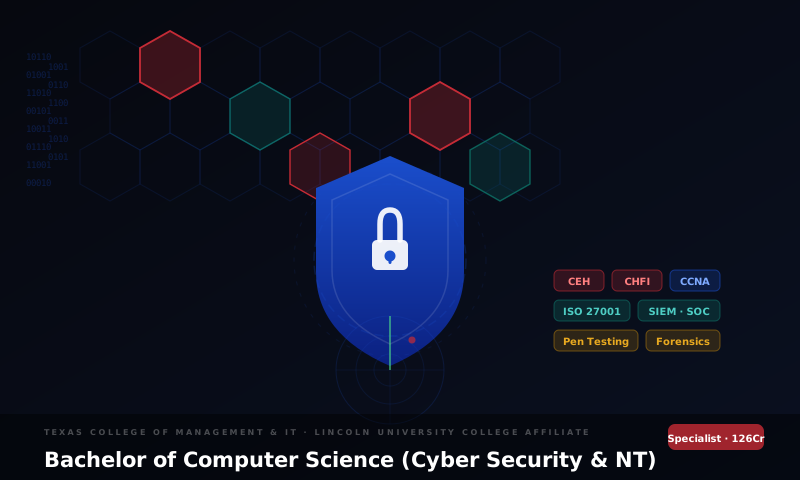
By integrating globally recognized cybersecurity certifications into the program, Texas College of Management & IT ensures students work with the same security tools and methodologies used by practitioners around the world.
Key point: Certifications are integrated directly into the BCS curriculum, allowing students to gain industry-recognized credentials while studying, not after graduation.
Professional Classes Offered
CompTIA Security+
In the second semester, students begin their professional track with CompTIA Security+, one of the most respected entry-level cybersecurity certifications in the world. It grounds them in core concepts, including network security, system security, identity management, risk management, cryptography, threat detection, and incident response—the essential stepping stone into information security.
HTB Certified Defensive Security Analyst (CDSA)
In the fourth semester, students advance to the HTB Certified Defensive Security Analyst (CDSA) certification. The focus shifts to defensive cybersecurity, building skills in SOC operations, security monitoring, log analysis, investigation, threat detection, digital forensics, and defensive response.
HTB Certified Penetration Testing Specialist (CPTS)
In the sixth semester, students take on the Hack The Box Certified Penetration Testing Specialist (CPTS) certification and step into offensive security. The course covers ethical hacking, vulnerability assessment, reconnaissance, exploitation techniques, privilege escalation, and post-exploitation — equipping students to run the offensive strategies employers actively seek today.
ℹ️ The three certifications map to a deliberate arc: foundations (Security+) → defense (CDSA) → offense (CPTS), giving graduates a full-spectrum view of modern cybersecurity.
Learn from Industry Experts
A defining feature of the BCS Professional Classes is the chance to learn directly from experienced cybersecurity professionals working in Nepal’s technology sector.
CompTIA Security+ is delivered by Aayush Pantha, Team Lead at SecureIQLab Pvt. Ltd., and Simran Karki, SOC Analyst Lead at CryptoGen Nepal. Their hands-on corporate experience means students learn the fundamentals through examples drawn from real cybersecurity environments.
HTB Certified Defensive Security Analyst (CDSA) is led by Srishti Poudel and Sushil Ojha, both Security Engineers at Cedargate Technologies. Students gain insight into Security Operations Center workflows, incident response, security monitoring tools, and the threat-detection processes used by working engineers.
HTB Certified Penetration Testing Specialist (CPTS) is taught by Venus Chhantel, Malware Researcher at Coding Mountain, offering students a practical look at penetration testing, malware analysis, vulnerability identification, and current offensive security practice.
Program Schedule
The BCS Professional Classes run from July 19, 2026, to July 31, 2026 — two weeks across 12 working days. Sessions are three hours each day, leaving ample room for theory, lab practice, discussion, and hands-on cybersecurity experience.
Why Choose Texas College of Management and IT for BCS?
Texas College of Management & IT continues to add value to its Bachelor of Computer Science by embedding certification preparation directly into the curriculum. Students no longer wait until after graduation to enter the industry — they acquire practical cybersecurity skills as they progress, guided by experienced instructors.
This blend of theoretical grounding, internationally certified programs, and hands-on training is what sets graduates up for successful careers in cybersecurity, network security, security operations, penetration testing, and digital defense.
Key Takeaways
- Three globally recognized certifications—Security+, HTB CDSA, and HTB CPTS are built into the BCS curriculum.
- A structured progression from foundations to defense to offense across semesters two, four, and six.
- Instruction from practicing cybersecurity professionals in Nepal’s tech sector.
- Hands-on labs, real cases, and mentoring over pure theory.