



The scope of BIT courses in Nepal is strong because graduates can work in software development, web development, cybersecurity, networking, cloud computing, database management, QA, and IT support. As Nepal’s IT, banking, e-commerce, and outsourcing sectors grow, BIT graduates have increasing opportunities in local companies, remote jobs, freelancing, startups, and higher studies abroad.
This page covers everything you need to know — what BIT is, what jobs are available after graduation, what salaries to expect, and why choosing the right BIT college makes all the difference.
What is BIT Course in Nepal?
BIT, also known as Bachelor of Information Technology, is a four-year undergraduate program divided into eight semesters, designed to give students a strong foundation in both the technical and practical sides of information technology.
The BIT curriculum covers software development, networking, database management, cybersecurity, web technologies, and IT project management. Unlike programs that are heavily theory-based, BIT places a strong emphasis on hands-on learning, lab work, and real-world project experience—making graduates job-ready from day one.
At Texas College of Management and IT, the BIT program is structured to develop both technical skills and professional communication abilities, preparing students for careers in Nepal and internationally.
Program Overview
- Full Form: Bachelor of Information Technology
- Duration: 4 Years / 8 Semesters
- Credit Hours: 129 Credit Hours
- University Affiliations: Tribhuvan University (TU), Lincoln University College (LUC — MQA Accredited), Ministry of Education (MOE) Recognized
- Intake: Fall and Spring
- Study Mode: Morning and Day shifts available
- Focus Areas: Software Development, Networking, Databases, Cybersecurity, Web Development, IT Management
Why BIT Has High Scope in Nepal

The scope of BIT in Nepal is expanding rapidly, and the reasons are clear.
Growing IT Industry
Kathmandu alone is home to hundreds of IT companies, software houses, and technology-driven organizations. Companies like Deerwalk, Leapfrog Technology, Cotiviti Nepal, F1Soft, and LogPoint hire IT graduates consistently throughout the year. The demand for skilled professionals far exceeds the current supply.
Banking and Financial Digitization
Every major bank and financial institution in Nepal is undergoing digital transformation. Mobile banking, digital wallets, and online payment systems have created strong demand for software developers, network administrators, database managers, and cybersecurity professionals across the financial sector.
E-commerce and Startups
Platforms like Daraz and SastoDeal, along with dozens of local startups, require web developers, UI/UX designers, and digital marketing tech specialists. The startup ecosystem in Kathmandu and Pokhara continues to grow, creating new and accessible entry points for fresh BIT graduates.
Outsourcing and Remote Work
Nepal is increasingly seen as a reliable software outsourcing destination. BIT graduates with strong coding and communication skills can work for international clients directly from Nepal, earning in foreign currency without having to leave the country.
Freelancing Market
Platforms like Upwork, Fiverr, and Toptal have a growing number of Nepali freelancers offering services in web development, mobile applications, and cybersecurity. Many BIT students begin freelancing from their second or third year itself, building both income and experience simultaneously.
Career Opportunities After BIT in Nepal
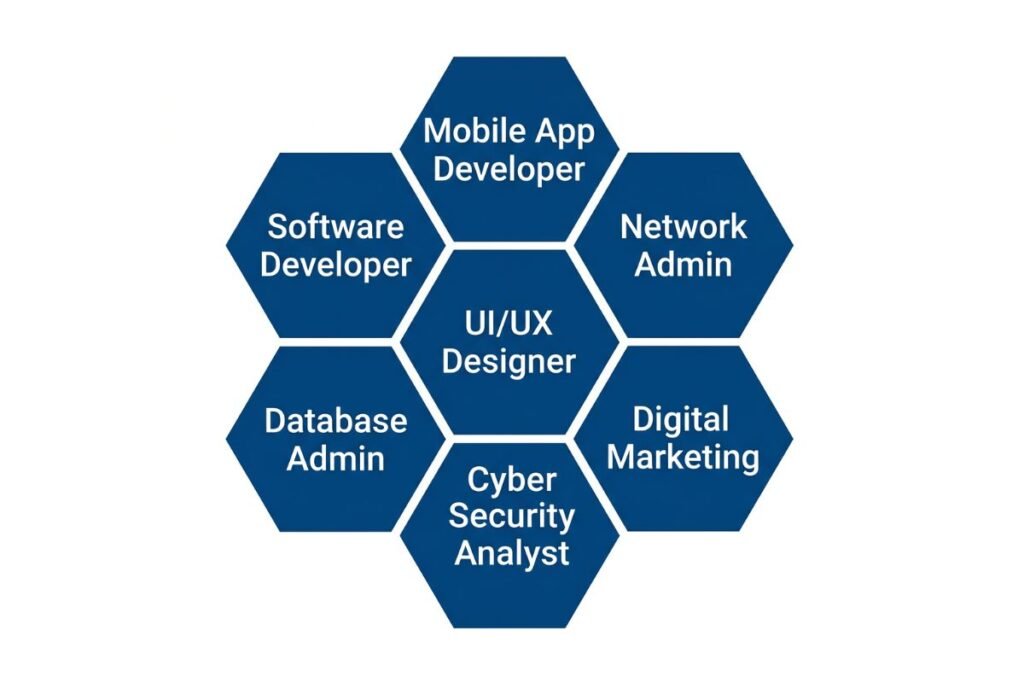
One of the strongest reasons students choose BIT is the wide range of job roles available after graduation. The IT sector in Nepal absorbs BIT graduates across multiple disciplines.
Software Developer
Develop and maintain applications for businesses, banks, government organizations, and startups. This is consistently one of the most in-demand roles in Nepal’s IT job market.
Web Developer
Build websites and web applications for companies, e-commerce platforms, and NGOs. Full-stack web developers are in particularly high demand across organizations of all sizes.
Mobile App Developer
Create Android and iOS applications for local and international clients. Mobile development is a fast-growing specialization, and Nepal has a strong base of freelance and employed mobile developers.
UI/UX Designer
Design the interface and user experience of digital products. Companies investing in their software products actively hire UX professionals, and the field is growing quickly in Nepal.
Network Administrator
Manage and maintain computer networks for organizations. Banking, telecom, and government sectors recruit network administrators on a regular basis.
Database Administrator
Design, maintain, and optimize databases for organizations running large IT systems. Every company with a significant IT presence needs database professionals.
Cybersecurity Analyst
Protect organizational networks and data from cyber threats. With increasing digitization across Nepal, cybersecurity is one of the fastest-growing career fields, and qualified professionals are in short supply. Texas College is a certified training partner for CEH and CHFI, giving BIT students a competitive edge in this field.
Cloud Engineer
Manage cloud infrastructure on platforms like AWS and Azure. Cloud roles are growing strongly in Nepali IT companies, particularly those serving international clients.
QA Engineer
Test software products for bugs and performance issues before release. Every software company requires quality assurance professionals, and this is one of the more accessible entry-level roles for fresh graduates.
IT Support Officer
Provide technical support across organizations. Banks, hospitals, schools, government offices, and telecom companies all employ IT support staff.
Digital Marketing Tech Specialist
Manage digital campaigns, SEO tools, analytics platforms, and marketing automation systems. The rise of e-commerce has increased demand for tech-oriented professionals in marketing roles.
BIT Salary in Nepal

A common question from prospective students is about BIT salary in Nepal. Here is a realistic and role-by-role breakdown based on current market conditions.
Salary by Experience Level
| Experience Level | Years of Experience | Monthly Salary (NPR) |
| Fresher | 0 – 1 Year | 25,000 – 45,000 |
| Mid-Level | 2 – 4 Years | 50,000 – 90,000 |
| Senior-Level | 5+ Years | 1,00,000 – 2,00,000+ |
Salary by Job Role
| Role | Fresher Salary (NPR/month) | Experienced Salary (NPR/month) |
| Software Developer | 30,000 – 45,000 | 80,000 – 1,50,000 |
| Web Developer | 25,000 – 40,000 | 70,000 – 1,20,000 |
| Mobile App Developer | 30,000 – 50,000 | 90,000 – 1,60,000 |
| Cybersecurity Analyst | 35,000 – 55,000 | 1,00,000 – 2,00,000 |
| Network Administrator | 28,000 – 45,000 | 70,000 – 1,20,000 |
| UI/UX Designer | 25,000 – 40,000 | 60,000 – 1,00,000 |
| QA Engineer | 25,000 – 40,000 | 60,000 – 1,00,000 |
| Database Administrator | 30,000 – 50,000 | 80,000 – 1,40,000 |
| Cloud Engineer | 35,000 – 55,000 | 1,00,000 – 1,80,000 |
Freelancing Income
BIT graduates who take up freelancing on international platforms can earn USD 500 to 3,000 or more per month depending on their skills and project volume. Web development, mobile applications, and cybersecurity consulting are especially well-paying for Nepali freelancers working with overseas clients.
Skills You Gain in BIT
The BIT program is structured to build a broad yet deep skillset that prepares you for multiple career paths.
Programming and Software Development
You will learn languages including Java, Python, C++, and PHP, along with software development methodologies and practices used in the industry today.
Database Management
Designing, querying, and maintaining relational databases using tools like MySQL, Oracle, and SQL Server — skills required in virtually every IT organization.
Networking
Fundamentals of computer networks, LAN/WAN configuration, and network security. At Texas College, students have access to CCNA certification training, which is one of the most recognized networking credentials worldwide.
Cybersecurity
Ethical hacking, digital forensics, information security principles, and cyber threat management. Texas College is a certified training partner for CEH, CHFI, and Security+ certifications, giving students a head start in one of the most in-demand fields in IT.
Web Development
HTML, CSS, JavaScript, and full-stack frameworks for building professional websites and web applications used by real organizations.
Project Work and Research
Real-world IT projects from the third year onwards, building practical problem-solving skills, teamwork, and the ability to deliver technology solutions independently.
Communication and Professional Skills
Presentations, technical report writing, and business communication — skills that set professionally prepared graduates apart in job interviews and workplace environments.
Future Scope of BIT in Nepal

Beyond immediate employment, the long-term future of BIT graduates in Nepal is promising across several directions.
Remote Jobs and International Clients
BIT graduates with strong technical skills are increasingly securing remote positions with companies in the US, the UK, Australia, and Southeast Asia—earning competitive salaries without relocating. This trend is growing every year as Nepali IT professionals build a stronger global reputation.
Higher Education Abroad
A BIT degree is recognized for admission to master’s programs in countries including Australia, Canada, the UK, Germany, and Malaysia. Many Texas College BIT alumni have gone on to pursue MS degrees in computer science, cybersecurity, data science, and information systems abroad.
Entrepreneurship and Startups
Nepal’s technology startup ecosystem is developing rapidly. BIT graduates with entrepreneurial drive can establish their own software products, SaaS platforms, IT consulting firms, or digital agencies. The combination of technical and business knowledge in the BIT curriculum supports this path well.
Industry Certifications
After completing BIT, graduates can deepen their expertise with certifications like AWS Certified Solutions Architect, CCNA, CEH, CHFI, Security+, and Google Cloud Professional. Texas College actively supports students in pursuing these credentials alongside their degree, giving graduates a portfolio that goes beyond just an academic qualification.
Emerging Technology Fields
Artificial intelligence, machine learning, blockchain, cloud computing, and data science are opening new and high-paying career paths globally. BIT graduates who upskill in these areas after graduation gain access to the most competitive IT roles both in Nepal and internationally.
BIT vs BSc CSIT vs BCA vs BIM
Many students compare BIT against other IT programs before making a decision. Here is a clear breakdown.
| Factor | BIT | BSc CSIT | BCA | BIM |
| Program Focus | Practical IT + Business | Science & Theory | Application Dev | Business + IT |
| Duration | 4 Years | 4 Years | 4 Years | 4 Years |
| Practical Weight | High | Moderate | Moderate | Low–Moderate |
| Industry Readiness | Very High | High | Moderate | Moderate |
| Cybersecurity | Strong | Moderate | Basic | Basic |
| Affiliation | TU / LUC / MQA | TU | TU / PU | TU |
| Best Suited For | Job-ready IT careers | Research / further study | Dev roles | Business IT |
BIT vs BSc CSIT
BIT is more application and industry-oriented, covering software, networks, databases, and cybersecurity with a practical approach. BSc CSIT has a heavier mathematical and theoretical base, which suits students who are interested in research or postgraduate academic study.
BIT vs BCA
BCA focuses more narrowly on application and software development. BIT covers a broader scope including networking, cybersecurity, and systems management, making graduates more versatile in the job market.
BIT vs BIM
BIM combines business management with basic IT. If your interest is specifically in technology careers and building deep technical expertise, BIT offers more comprehensive preparation than BIM.
Top BIT Colleges in Nepal
Tribhuvan University (TU) Affiliated BIT Colleges
Numerous colleges across Kathmandu, Pokhara, Chitwan, and other cities are affiliated with Tribhuvan University and offer BIT programs. TU affiliation is widely recognized across government and public sector organizations in Nepal.
Pokhara University (PU) Affiliated Colleges
PU-affiliated colleges offer structured BIT programs and are particularly established in the western region of Nepal, including Pokhara and surrounding districts.
Internationally Affiliated BIT Colleges
Texas College of Management and IT, located in Sifal, Chabahil, Kathmandu, offers BIT affiliated with Lincoln University College (LUC), accredited by MQA and recognized by the Ministry of Education Nepal. This international affiliation gives graduates a degree recognized for employment and further study abroad.
Texas College’s BIT program is distinguished by its partnerships with global technology organizations, including AWS, Cisco, EC-Council, Kaspersky, and Red Hat, as well as its dedicated Career Service Center and TexasJobs portal for students and alumni.
BIT Course Eligibility in Nepal
Admission to the BIT program in Nepal is open to students from any stream at the +2 level.
- Completion of +2 (Grade 12) or equivalent qualification from a recognized board in any discipline
- Minimum 50% marks in aggregate (requirements may vary slightly by college and affiliation)
- For internationally affiliated programs such as LUC, supporting academic documentation is required during the admission process
- Some colleges conduct an entrance exam or interview as part of their selection process
Why Choose Texas College for BIT in Nepal
Texas College of Management and IT, established in 2009, is one of the leading IT colleges in Kathmandu. The BIT program here offers:
- International degree recognition through Lincoln University College (LUC) affiliation—MQA accredited and MOE recognized
- Embedded certification training—CCNA, CEH, CHFI, AWS, Security+, and more alongside your degree
- Dedicated career services through the Texas Career Service Center (CSC) and TexasJobs portal
- Internship opportunities from the 7th semester
- Faculty led by certified professionals including CISA, CEH, CHFI, and CCNA holders
- Industrial partnerships with Kaspersky, AWS, Cisco, EC-Council, Red Hat, and more
- 95% placement support for graduates
- Students placed in companies in Nepal and abroad
Frequently Asked Questions
What is the scope of BIT in Nepal?
The scope of BIT in Nepal is strong and growing. BIT graduates can work as software developers, web developers, cybersecurity analysts, network administrators, database administrators, and more. Nepal’s expanding IT industry, banking digitization, and outsourcing sector all create consistent demand for qualified BIT graduates.
Is BIT good for the future in Nepal?
Yes, BIT is an excellent choice for the future. The IT sector in Nepal is one of the fastest-growing sectors in the country. Demand for skilled technology professionals is increasing every year, and BIT provides the practical foundation needed for a long-term career in IT — both in Nepal and internationally.
What jobs can I get after BIT in Nepal?
After BIT, you can work as a software developer, mobile app developer, web developer, UI/UX designer, network administrator, database administrator, cybersecurity analyst, QA engineer, cloud engineer, IT support officer, or digital marketing tech specialist, among others.
What is the BIT salary in Nepal?
A fresh BIT graduate can expect a salary of NPR 25,000 to 45,000 per month in Nepal. With 2 to 4 years of experience, this typically rises to NPR 50,000 to 90,000. Senior-level professionals with 5 or more years of experience can earn NPR 100,000 and above. Freelancing can supplement income significantly.
Is BIT better than BCA?
BIT covers a broader range of IT disciplines, including networking, cybersecurity, and systems administration, in addition to software development. BCA focuses more on application development. For students who want versatility and multiple career options in the IT field, BIT is generally considered a stronger choice.
Can BIT students work abroad?
Yes. BIT graduates can work abroad in IT roles, pursue higher studies in countries like Australia, Canada, UK, and Germany, or work remotely for international clients while living in Nepal. An internationally recognized BIT degree, such as the one offered at Texas College through its LUC affiliation, strengthens these opportunities considerably.