



The scope of BCS in Nepal in 2026 is widest in cyber security, cloud infrastructure, and software development, with entry level roles starting around NPR 35,000 per month. Banks, telecom operators, fintech platforms, and government offices are now hiring computer science graduates faster than Nepali colleges can produce them.
This guide covers what a Bachelor of Computer Science actually teaches, which career paths pay best, what real salary bands look like at each experience level, and how BCS compares against BCA and BIT before you commit four years to it.
In This Article
- What Is BCS? Bachelor of Computer Science Explained
- What Is the Scope of BCS in Nepal in 2026?
- Career Opportunities After BCS in Nepal
- BCS Salary in Nepal: Entry, Mid, and Senior Level
- Why Cyber Security Offers the Widest Scope
- BCS vs BCA vs BIT: Which Should You Choose?
- Eligibility, Fees, and Admission
- Where to Study BCS in Nepal
- Frequently Asked Questions
What Is BCS? Bachelor of Computer Science Explained
BCS stands for Bachelor of Computer Science. It is a four year undergraduate degree that trains you to build software, secure networks, manage data, and solve technical problems that businesses face every day.
Most BCS programmes in Nepal run across eight semesters. At Texas College of Management & IT, for example, the programme carries 130 credit hours spread over those eight semesters.
The core subjects you can expect include:
- Programming fundamentals, data structures, and algorithms
- Database management systems and software engineering
- Computer networking, routing, and switching
- Operating systems and system administration
- Web and mobile application development
- Artificial intelligence, cloud computing, and cyber security
ℹ️ BCS is not always a general degree. Some Nepali colleges offer it with a declared specialisation. Texas College runs its programme as BCS (Hons) in Network Technology and Cyber Security, which narrows the focus toward defensive security and infrastructure from the early semesters onward.
What Is the Scope of BCS in Nepal in 2026?
Three forces are driving demand for computer science graduates in Nepal right now, and all three point the same direction.
Rs 7.25bn
Allocated to ICT projects in FY 2081/82
52 / day
Cybercrime cases recorded last fiscal year
41%
Of those cases were financial fraud
Government investment in the IT sector
The Government of Nepal declared 2024 to 2034 the “IT Decade” and allocated Rs 7.25 billion to ICT projects in FY 2081/82. That funding is going into broadband expansion, IT park development, and digital payment infrastructure, all of which need staffing.
A cybercrime surge that outpaces defence capacity
Nepal recorded an average of 52 cybercrime cases per day in the last fiscal year, according to Nepal Police Cyber Bureau data reported by The Kathmandu Post. Financial fraud alone accounted for 7,723 cases, roughly 41 percent of the total, and rose almost 88 percent year on year.
Every bank, wallet provider, and telecom operator responding to that trend needs people who can secure systems. Nepal does not currently have enough of them.
Digital transformation across traditional sectors
Commercial banks, hospitals, insurance companies, and even schools are migrating operations online. Each migration creates roles that did not exist locally five years ago: cloud engineer, DevOps engineer, SOC analyst, data engineer.
Career Opportunities After BCS in Nepal
A BCS degree does not lock you into one job title. It opens three broad tracks, and most graduates move between them during their careers.
Cyber Security and Network Defence
This is currently the highest-leverage track for BCS graduates in Nepal. As organisations digitise, protecting customer data and payment systems moves from optional to mandatory.
Typical roles include SOC analyst, network security engineer, penetration tester, and digital forensics analyst. Employers include commercial banks, payment service providers, telecom operators, government departments, and IT outsourcing firms.
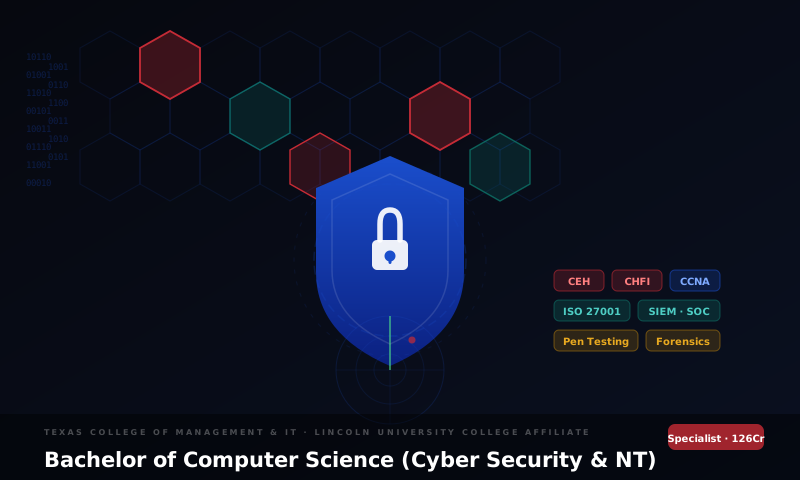
Graduates who pair the degree with vendor certifications such as Cisco CCNA and EC-Council Certified Ethical Hacker (CEH) tend to clear technical interviews faster than those who hold the degree alone.
Software and Application Development
Development remains the largest single employer of computer science graduates in Nepal by headcount. Every organisation running a website, mobile app, or internal system needs people to build and maintain it.
Common roles are software developer, web developer, mobile app developer, and full stack developer. Commercially relevant stacks in the Nepali market include JavaScript with React and Node.js, Python, Java, Laravel, and Flutter.
Hiring concentrates in software product companies, IT export and outsourcing firms, banks with in-house development teams, and e-commerce platforms.
Data Science, AI, Cloud and DevOps
This is the newest track in Nepal and the thinnest on local talent, which works in your favour. Roles include data analyst, machine learning engineer, cloud engineer, DevOps engineer, and database administrator.
These positions reward a mix of technical and analytical skill. AWS and Microsoft Azure certifications carry real weight here, since most Nepali companies moving to cloud are building on one of the two.
Which Sectors Actually Hire BCS Graduates in Nepal
If you want a concrete picture of where the jobs sit, these are the sectors advertising computer science roles most consistently:
- Banking and financial institutions: core banking systems, digital channels, information security units
- Telecom operators: network operations, infrastructure, security operations centres
- Fintech and payment service providers: wallet platforms, fraud detection, backend engineering
- IT export and outsourcing firms: development work for overseas clients, often at above-average pay
- Government and public agencies: e-governance projects, national digital infrastructure
- Hospitals, insurers, and education groups: systems administration, data management, internal IT
BCS Salary in Nepal: Entry, Mid, and Senior Level
Salary depends on your technical stack, certifications, portfolio, and the type of employer. IT export firms and banks generally pay above the local median. The ranges below reflect monthly gross salaries observed in Nepali job listings.
| Job Role | Entry (NPR/month) | Mid (NPR/month) | Senior (NPR/month) |
|---|---|---|---|
| Software Developer | 35,000 – 55,000 | 60,000 – 90,000 | 100,000 – 150,000 |
| Cyber Security Analyst | 35,000 – 55,000 | 60,000 – 90,000 | 100,000 – 140,000 |
| Cloud / DevOps Engineer | 40,000 – 60,000 | 65,000 – 100,000 | 110,000 – 160,000 |
| Data Analyst / AI Engineer | 30,000 – 50,000 | 55,000 – 80,000 | 85,000 – 130,000 |
| Network Engineer | 30,000 – 50,000 | 55,000 – 70,000 | 75,000 – 140,000 |
💡 Two things raise these numbers meaningfully. The first is certification: CCNA, CEH, AWS, and Azure credentials consistently move candidates into higher bands. The second is remote and freelance work for international clients, which can pay several times the domestic range for the same skill set.
Why Cyber Security Offers the Widest Scope
Among all BCS specialisations, cyber security currently has the strongest combination of local demand, global portability, and salary growth.
The local case is straightforward. With cybercrime complaints rising sharply and financial fraud making up the largest share, every organisation handling money or customer data is under pressure to hire defensive talent. Banks, payment providers, hospitals, telecoms, and government bodies are all recruiting in this space.
A SOC analyst in Kathmandu can work remotely for a firm in Singapore or Dubai without needing local licensing, which is not true of most other professions.
The global case matters just as much. Cyber security skills transfer across borders with almost no friction, which makes this one of the few Nepali degree paths where international remote work is realistic straight out of college.
A practical certification path for BCS students looks like this:
- Cisco CCNA for networking fundamentals, usually attempted in the middle semesters.
- EC-Council CEH for offensive security and vulnerability assessment.
- CHFI or a cloud security credential for specialisation in the final year.
Texas College embeds several of these certifications inside the academic programme, including CCNA, CEH, CHFI, AWS, Red Hat, Fortinet, and Kaspersky training, so students are not paying for them separately outside college.
BCS vs BCA vs BIT: Which Should You Choose in Nepal?
This is the question most +2 graduates get stuck on. All three are four year IT degrees, but they differ in focus and affiliation.
| Aspect | BCS | BCA | BIT |
|---|---|---|---|
| Core focus | Computer science theory, networking, security, systems | Computer applications, software development, business IT | Applied IT, systems, and information management |
| Typical affiliation | Foreign university affiliation, Malaysia-based | Tribhuvan University | Purbanchal University and foreign affiliates |
| Duration | 4 years, 8 semesters | 4 years, 8 semesters | 4 years, 8 semesters |
| Best suited for | Students targeting security, networking, or research-oriented roles | Students targeting application development and general IT roles | Students targeting IT operations and enterprise systems |
| Degree recognition | Internationally recognised; check equivalence for government jobs | Nationally recognised; straightforward for government service | Varies by affiliating university |
The short version: choose BCS if you want depth in networking, security, or systems and are comfortable with a foreign-affiliated degree. Choose BCA if you want the most conventional TU route into general software work. Choose BIT if enterprise IT and information systems interest you more than pure computer science.
BCS Eligibility, Fees, and Admission in Nepal
Eligibility Requirements
- Completed +2, NEB, CBSE, A-Level, or equivalent from a recognised board
- Minimum 50 percent aggregate in the qualifying examination
- Open to all streams, including Science, Management, Humanities, and Hotel Management
- Applicants with foreign qualifications must submit a Nepal equivalence certificate where applicable
Note that most BCS programmes do not require a Science background. Students from Management and Humanities streams are eligible, though those without prior mathematics may need extra support in the early programming semesters.
What BCS Costs in Nepal
⚠️ EDITOR NOTE — DELETE BEFORE PUBLISHING. Insert the confirmed TCMIT BCS total programme fee, per-semester breakdown, and scholarship slabs in the paragraph below, then remove this callout. Do not publish with the placeholder in place.
Total programme fees for a foreign-affiliated BCS degree in Kathmandu typically fall in the range of [INSERT CONFIRMED FEE] for the full four years, usually payable per semester. Merit, need-based, regional, and skill-based scholarships are available to eligible applicants.
Intake and Application Process
- Applications open once per academic year for the Fall intake, during Shrawan and Bhadra.
- Submit the completed application form with your academic transcripts and required documents.
- The admissions committee reviews your application, typically within 48 hours.
- Shortlisted applicants are called for an entrance assessment and interview.
Where to Study BCS in Nepal

Before shortlisting colleges, check these six things. They separate programmes that lead to jobs from programmes that only lead to a certificate.
- Affiliation and recognition: which university awards the degree, and whether it is accepted for the career path you want
- Lab infrastructure: dedicated networking and security labs, not shared general-purpose computer rooms
- Embedded certifications: whether industry credentials are built into the programme or sold separately
- Faculty background: industry experience alongside academic qualifications
- Internship and placement support: named partner companies, not vague promises
- Graduate outcomes: ask where the last two graduating batches are working now
Why Students Choose BCS (Hons) at Texas College of Management & IT
Texas College of Management & IT at Siphal, Chabahil, Kathmandu offers the Bachelor of Computer Science (Hons) in Network Technology and Cyber Security in affiliation with Lincoln University College, Malaysia. The programme runs four years across eight semesters and 130 credit hours.
What distinguishes the programme in the Kathmandu market:
- Security specialisation from the start. The degree is built around network technology and cyber security rather than treating security as one elective.
- Certifications inside the curriculum. CCNA, CEH, CHFI, AWS, Red Hat, Fortinet, and Kaspersky training are embedded in the academic programme.
- Dedicated labs. Cyber security labs, an AI lab, and a robotics lab, alongside the Lincoln Learning Centre and digital library.
- Industry partnerships. Working relationships with Cisco, AWS, Kaspersky, Red Hat, Fortinet, and Nepali IT companies.
- Mandatory internships and placement support through the Career Services Centre and the Texas Jobs Portal.
The IT department is headed by Suman Thapaliya, who holds a Master of Science from London Metropolitan University, UK, and oversees the BCS, BIT, and MCS programmes.
Frequently Asked Questions
Is BCS a good course in Nepal?
Yes. BCS gives you a foundation in programming, networking, systems, and security, which maps directly to the roles Nepali banks, telecoms, and IT firms are hiring for. It is a particularly strong choice if you want to specialise in cyber security.
What is the scope of BCS in Nepal after graduation?
BCS graduates in Nepal typically move into cyber security, software development, cloud and DevOps, data analysis, or network engineering. Demand is currently strongest in security and cloud roles, where local supply is thinnest.
What is the average salary after BCS in Nepal?
Fresh BCS graduates generally earn NPR 30,000 to 55,000 per month depending on role and employer. Mid-level professionals earn NPR 55,000 to 100,000, and senior specialists with certifications can exceed NPR 150,000.
Is BCS better than BCA or BIT?
Neither is universally better. BCS goes deeper into computer science, networking, and security. BCA is the standard TU route into application development. BIT focuses on applied and enterprise IT. Choose based on the career track you want, not the label.
Can I study BCS without a Science background?
Yes. Most BCS programmes in Nepal accept students from Management, Humanities, and Hotel Management streams with a minimum 50 percent aggregate. Students without prior mathematics may need extra support in early programming subjects.
How long does BCS take to complete in Nepal?
BCS is a four year programme delivered across eight semesters. At Texas College the degree carries 130 credit hours, including project work and a mandatory internship.
Can BCS graduates study abroad or work internationally?
Yes. A BCS degree from an internationally affiliated university is recognised for postgraduate applications abroad, subject to each institution’s requirements. Cyber security and cloud skills also transfer well to remote work for overseas employers.
Key Takeaways
- ✓ The scope of BCS in Nepal is widest in cyber security, cloud, and software development.
- ✓ Entry level salaries start around NPR 30,000 to 55,000 and rise sharply with certifications.
- ✓ Cyber security offers the best combination of local demand and international portability.
- ✓ BCS suits security and systems careers; BCA and BIT suit application and enterprise IT.
- ✓ Certifications, a project portfolio, and an internship matter more than the degree alone.
Conclusion
The scope of BCS in Nepal in 2026 is broader than it has been at any previous point, and the gap between demand and available talent is widest in cyber security and cloud infrastructure. Students who leave the degree with real certifications, a project portfolio, and an internship on record are entering a market that has more openings than qualified candidates.
Key point: The degree alone is not the differentiator. What you do alongside it is.
References
- Nepal recorded 52 daily cybercrime cases last fiscal — The Kathmandu Post, July 2025.
- Government of Nepal ICT allocation, FY 2081/82 — Ministry of Finance budget statement.
- Salary ranges compiled from IT listings on Merojob, Kumari Job, and JobsNepal, August 2026.