

MBA for Working Professionals in Nepal
📅 July 12, 2026
✍️ Texas College Editorial Team
🕐 8 min read
You already have a job, and probably a decent one. What you don’t have is a clear answer to the scheduling question: can an MBA actually fit around a full-time career, or is that just something colleges say in their brochures?
If you’ve already decided an MBA is the right next step and you’re now evaluating logistics, class timing, and which program actually respects your calendar, this page is for you.
Key Takeaways
- ✓ A part-time, evening-format MBA lets you keep your salary and your job while you study, instead of pausing your career for two years.
- ✓ Look for programs built specifically around working adults: evening or weekend classes, a cohort of peers who are also employed, and faculty with real industry experience.
- ✓ Texas College of Management and IT runs its MBA on an evening schedule under the Lincoln University College, Malaysia affiliation, from its Kathmandu campus.
- ✓ Several Nepali colleges share the same foreign university affiliation. What differs is the class format, campus, faculty mix, and cohort, so it’s worth comparing those specifics rather than the affiliation alone.
Why an MBA While Working Makes Sense
The strongest reason to do an MBA while employed is immediate: what you learn on Tuesday, you can apply at work on Wednesday. A finance module lands differently when you’re already reading your company’s budget reports. A strategy case discussion means more when you’re sitting in similar meetings the same week.
That immediacy also protects your income. A full-time residential MBA usually means stepping away from a salary for one to two years, plus tuition. An evening or part-time format lets you keep earning while you study, which changes the entire cost equation of the degree. For most working Nepali professionals, the real ROI question isn’t “is an MBA worth it,” it’s “is an MBA worth it if I have to quit my job for it,” and those are very different questions with very different answers.
There’s also the employer-sponsorship angle. Mid-career upskilling is increasingly something Nepali employers are willing to support, whether through partial tuition assistance, flexible leave for exams, or simply not blinking when you ask to leave at 4:30 twice a week for class. Even without formal sponsorship, staying employed through the program avoids the opportunity cost of two blank years on your resume.
What to Look for in a Working-Professional MBA Program
Not every MBA labeled “flexible” actually works around a full-time job. The honest test is whether the schedule was designed for working adults from the start, or whether it’s a daytime program with a few evening sections bolted on.
Here’s what actually matters when you’re evaluating options:
- Evening or weekend scheduling as the default, not an exception you have to request. Classes should consistently run after standard office hours, not shift week to week.
- A cohort of peers who are also working. The classroom dynamic changes completely when everyone around you is balancing a job, not just recently out of a bachelor’s program. Case discussions get sharper because people are pulling from live work experience, not textbook scenarios.
- Faculty with real industry or executive experience, not purely academic backgrounds. A professor who has actually managed a team, run a budget, or handled a difficult client brings something a pure lecturer can’t.
- Reasonable flexibility around attendance and makeup sessions. Work emergencies happen. A program that treats one missed evening as a crisis isn’t built for working adults, whatever its marketing says.
Talk to anyone who has actually finished an evening MBA in Kathmandu and they’ll tell you the same thing: the degree is only half the value. The other half is sitting next to people who work in banking, telecom, or manufacturing and hearing how they’d handle the same case study you’re studying, from inside a different industry.
The MBA Format at Texas College of Management and IT
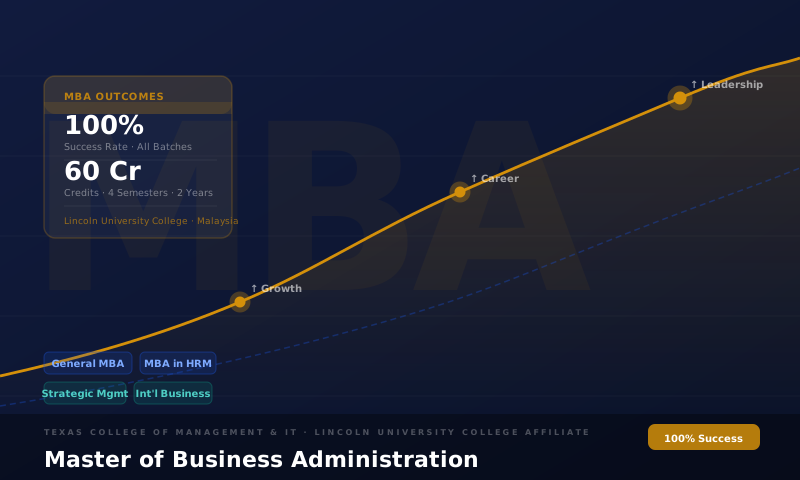
The MBA at Texas College of Management and IT is structured specifically for people who have a job during the day. Classes are scheduled in the evening, so you attend after office hours rather than requesting leave to study.
The program is offered under the college’s foreign university affiliation, which means the curriculum, course structure, and final credential follow that university’s academic framework, delivered from the Kathmandu campus. That gives students a foreign-affiliated MBA without relocating or studying abroad, while classes stay grouped by trimester or semester through a defined multi-year track built around evening delivery.
If you want the specific intake dates, current fee structure, and full module breakdown, the MBA program page has the details as they stand for the current admission cycle. That’s also where you’ll find entry requirements and how prior academic background factors into eligibility.
If you’ve searched for “MBA in Nepal with a Malaysia affiliation,” you’ve probably noticed more than one Nepali college carries that same affiliation. That’s accurate, and there’s no point pretending otherwise. The affiliation itself, the Malaysia-based academic framework behind the degree, is shared across more than one institution in Nepal.
What differs between those options isn’t the affiliation. It’s the actual delivery: campus location, class timing, faculty composition, and who else is sitting in the room with you. Texas College of Management and IT runs its MBA specifically as an evening program, built around a cohort of working professionals from its Kathmandu campus, with faculty drawn from people who bring current industry or executive backgrounds into the classroom.
So the honest way to choose between these foreign-affiliated options in Nepal isn’t to ask “which one has the Malaysia affiliation,” since more than one does. Ask instead: which schedule actually fits my job, which campus is realistic for my evening commute, who’s teaching the courses, and who else is in the cohort. Those are the factors worth comparing college to college, and they’re the ones that will actually shape your two years in the program. You can review TC’s MBA program details directly and compare the schedule and faculty information against any other option you’re considering.
Is an MBA Worth It While Working in Nepal?
For most working professionals, the honest answer is: it depends on what you do with it, but the structural case is solid. Keeping your job through the program means you avoid the two-year income gap a full-time MBA usually requires, while still building the credential and network that tend to open doors toward management-track roles.
The clearest, most defensible benefits are the ones you can reasonably expect without needing a specific number to back them up: broader exposure to strategy, finance, and operations beyond your current role; a professional network built from classmates who are managers and specialists across other industries; and a credential that signals you’ve formalized the skills you may already be using informally at work.
Rather than treating an MBA as a guaranteed salary jump, it’s more realistic to treat it as a career accelerant, something that makes you a stronger candidate for the promotion or move you were already positioning for. Whether that translates into a specific raise or title change depends heavily on your industry, your employer, and what you actually do with the network and coursework, not on the degree alone.
FAQ
Can I do an MBA in Nepal while working full-time?
Yes. Evening and part-time MBA formats in Nepal are specifically designed for this. Classes run after standard office hours, so you attend college in the evening and keep your job during the day, without needing to take extended leave.
How long does a part-time/evening MBA take?
An evening MBA typically runs across multiple semesters or trimesters over roughly two years, similar in total duration to a full-time program but paced around evening class delivery rather than daytime study. Exact duration depends on the specific college and curriculum structure.
Do Nepali employers value a foreign-affiliated MBA?
Many employers in Nepal do recognize the value of a foreign-affiliated MBA, particularly one built on an established international curriculum, since it signals exposure to a broader academic framework than a purely domestic program. That said, value ultimately depends on your industry and how you present the degree alongside your work experience.
What’s the class schedule like for working professionals?
Evening-format MBA programs generally schedule classes after typical office hours, several evenings a week, so students can leave work and go directly to class. Some programs also build in flexibility for makeup sessions when work commitments interfere with a scheduled class.
Is financial or tuition support available for employed students?
Some employers in Nepal offer partial tuition assistance or flexible scheduling for staff pursuing graduate study, though this varies significantly by company and industry. It’s worth raising the conversation directly with your employer before assuming support isn’t available, and separately checking with the college about any installment or fee structure options.
Ready to Apply?
If you’ve read this far, you’ve likely already made the decision, and what’s left is the paperwork. The MBA at Texas College of Management and IT is built around the evening schedule, working cohort, and foreign-affiliated curriculum described above.
Review the full MBA program page for current intake dates, fees, and entry requirements, then head to admissions to apply now when you’re ready to start. If you still have scheduling or eligibility questions first, that’s exactly what the admissions team is there to answer before you commit.