



Choosing a BIT course in Nepal is a four-year commitment of your time, your money and your early career. Most students who regret the decision did not pick the wrong subject — they picked it for the wrong reasons. Here are the ten mistakes that come up again and again, and what to do instead.
What Is a BIT Course?
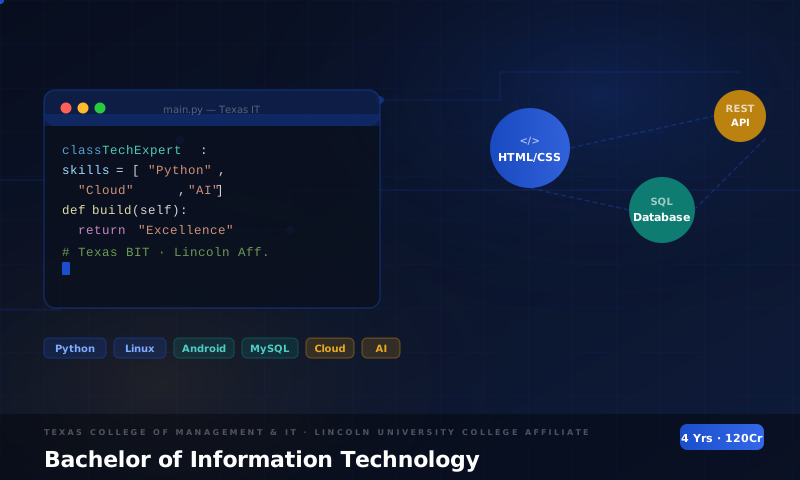
BIT stands for Bachelor of Information Technology. It is a four-year undergraduate degree covering software development, networking, databases and IT systems management. In Nepal it is offered by colleges affiliated with foreign universities and Purbanchal University, so the syllabus can differ noticeably from one college to another.
What You Study in a BIT Programme
- Programming languages such as Java, Python and C#
- Web and mobile application development
- Database management systems
- Networking and cybersecurity fundamentals
- Software project management
- A final-year capstone or industry project
ℹ️ BIT is not only coding. Roughly a third of most BIT syllabi is networking, systems and project work. If you enjoy building and organising systems as much as writing code, that is a good sign.
Why Your BIT Choice Matters

The college you pick decides more than your certificate. It shapes the syllabus you study, the labs you use, the internships you can reach and the people you graduate alongside. A dated curriculum and weak industry links will cost you the first two years of your career. A well-run programme puts you in front of employers before you have even finished.
Key point: You are not choosing a subject for four years. You are choosing the first five years of your working life.
10 Common Mistakes While Choosing a BIT Course
Every one of these is avoidable with a few hours of honest research. Read them before you fill out a single application form.
1. Choosing BIT because your friends chose it
Following your circle into a programme you have not researched is the fastest route to a demotivating second year. Ask yourself plainly: do you enjoy technology, logical reasoning and problem-solving? If the honest answer is no, BIT will feel like a long four years.
2. Not knowing what the course actually covers
Many students assume BIT is pure programming and are surprised by the networking, database and project management modules. Download the full syllabus from every college on your list and read it, semester by semester.
3. Ignoring eligibility and admission requirements
Eligibility varies by college. Some require an entrance test, some set a minimum GPA, and foreign-affiliated programmes may ask for English language evidence. Check the exact criteria for each college early — not the week before the deadline.
⚠️ Entrance dates and application deadlines are often published only on the college website or notice board. Confirm them directly with the admissions office rather than relying on social media posts.
4. Choosing a college on reputation alone
A well-known name does not guarantee current labs or small class sizes. Some highly regarded colleges run crowded sections and ageing equipment, while lesser-known ones invest heavily in faculty and facilities. Judge what you can see, not what you have heard.
5. Deciding on tuition fees alone
The cheapest option can cost you more later if the teaching, labs and placement support are thin. The most expensive one is not automatically better either. Compare what each fee actually buys: contact hours, lab access, faculty qualifications, internship support.
6. Not comparing the curriculum college by college
Two BIT programmes under the same university are not identical. Electives, project weightage and how recently the technology modules were updated all differ. Put the syllabi side by side before you shortlist.
7. Overlooking internships and placement support
Hands-on experience before graduation is what separates two candidates with the same marks. Ask which companies take the college’s interns, how many students were placed last year, and whether career guidance is a real service or a line in the brochure.
8. Not checking faculty and campus facilities
Working computers, reliable internet and a usable library are basic requirements for an IT degree. Visit the campus in person and speak to current students. Twenty minutes on site tells you more than any prospectus.
9. Choosing without a long-term goal in mind
Software development, higher study abroad and starting your own venture are three different destinations, and they reward different programmes. Decide roughly where you are heading, then pick the course that gets you there.
10. Deciding in a hurry
The single most common mistake is rushing. Comparing colleges, reading syllabi and speaking to alumni takes a few weekends. Regretting the choice takes four years.
NOTE: Spend two weeks choosing, so you do not spend two years wishing you had chosen differently.
How to Choose the Right BIT College in Nepal
Work through this checklist for each college on your shortlist. If a college cannot answer one of these questions clearly, treat that as information too.
- Confirm the university affiliation and that it is current.
- Compare the full syllabus and available electives across colleges.
- Check faculty qualifications and the student-to-teacher ratio.
- Visit the labs, library and classrooms yourself.
- Ask for last year’s internship and placement record.
- Speak to two current students and one recent graduate.
- Weigh total value against total cost, not the fee alone.
- Note the eligibility criteria, entrance date and application deadline.
💡 Take a parent or an older sibling on the campus visit. A second set of eyes catches things you will miss when you are nervous.
BIT vs BCA vs BIM
These three degrees are often confused because they overlap. The difference is where the emphasis sits.
| Focus | BIT | BCA | BIM |
|---|---|---|---|
| Main emphasis | IT systems, networking and applied software | Computer applications and programming | Information technology combined with management |
| Duration | 4 years | 4 years | 4 years |
| Best suited to | Students who want practical, industry-facing IT skills | Students focused on software and application development | Students aiming for IT roles with a business angle |
| Typical first roles | Developer, network or database administrator, QA engineer | Software or web developer, application support | Business analyst, IT officer, systems coordinator |
There is no universally better option among the three. Match the degree to the work you want to be doing at 25, and compare the actual syllabi at the colleges you are considering.
- ✓ Choose BIT for your own interest in technology, not because your friends did.
- ✓ Read the full syllabus before you shortlist — BIT is more than programming.
- ✓ Judge colleges on labs, faculty and placements, not on reputation or fees alone.
- ✓ Visit the campus and talk to current students before you decide.
- ✓ Give yourself weeks, not days, to make the choice.
Frequently Asked Questions
Is BIT worth studying in Nepal?
Yes, if you are genuinely interested in software, networking and IT systems. Nepal’s software companies, bank IT departments, telecom operators and outsourcing firms all hire IT graduates, and demand has grown steadily.
What is the scope of BIT in Nepal?
Graduates work across software development, banking IT, telecommunications and outsourced services. The same skills also transfer well if you later choose to study or work abroad.
What jobs can I get after BIT?
Common first roles include software developer, web developer, network administrator, database administrator, QA engineer and IT support specialist.
What is the eligibility for BIT in Nepal?
You generally need to have passed +2 or an equivalent in any stream, with science or management including mathematics preferred, and to meet a minimum GPA. Some colleges also run an entrance test. Confirm the exact requirement with each college.
How should I prepare before starting BIT?
Get comfortable with basic computer operations, brush up your logical reasoning, and try a beginner course in one language such as Python. A few weeks of preparation makes the first semester far easier.
How do I identify a good BIT college?
Look for current university affiliation, an up-to-date syllabus, qualified full-time faculty, working labs, and a documented internship and placement record. Ask each college for specifics and compare the answers.
Choose Carefully, Once
Avoiding these ten mistakes costs you a few weekends of research. It saves you from the far more expensive alternative — realising in your second year that the programme was never the right fit. Compare the colleges, read the syllabi, visit the campuses, and choose the best BIT college in Nepal.