


Hotel Management & Hospitality Courses in Nepal: Is It Right for You?
📅 July 12, 2026
✍️ Texas College Editorial Team
🕐 12 min read
Nepal’s tourism sector has long been one of the country’s most talked-about growth stories, and hotel management is one of the few degree paths that puts you directly inside that story. Yet many +2 students still treat hospitality as a fallback choice rather than a serious career decision. It shouldn’t be.
A hospitality or hotel management degree trains you for real, structured roles: front office operations, food and beverage service, housekeeping management, event coordination, and tourism planning. It also happens to be one of the most hands-on degrees available after +2, built around internships rather than only lectures.
This guide to hotel management courses in Nepal walks through what a hospitality degree actually covers, who can study it, what BHM (Bachelor of Hospitality Management) specifically involves, where the career can take you beyond hotel floors, and how to evaluate institutes so you’re not choosing based on a listicle ranking alone.

Key Takeaways
- ✓ Hospitality is open to every +2 stream, science, management, commerce, or humanities, unlike IT or engineering paths that expect a specific background.
- ✓ BHM programs are built around practical training: front office, food and beverage, housekeeping, and internships alongside classroom learning.
- ✓ Career options extend well past hotel floors into travel, airlines, event management, and tourism consulting.
- ✓ Choosing the right institute matters more than choosing the “right” degree name; industry partnerships and practical facilities are the real differentiators.
In This Article
- What Do Hotel Management Courses in Nepal Cover?
- Who Can Study Hotel Management After +2?
- BHM (Bachelor of Hospitality Management) Explained
- Tourism & Hospitality — Broader Career Options Beyond Hotels
- Career Scope in Hospitality in Nepal
- Choosing a Hotel Management Institute in Nepal
- FAQ
- Ready to Explore Hospitality as a Career?
What Do Hotel Management Courses in Nepal Cover?
Hotel management courses in Nepal, and hospitality degrees generally, cover five core operational areas: front office, food and beverage service, housekeeping, tourism management, and overall hotel operations, combined with substantial hands-on internship hours rather than classroom theory alone. This mix of operational training and applied practice is what separates a hospitality degree from a general business degree.


💡 Quick Fact: A hospitality degree curriculum in Nepal typically blends four operational pillars, front office, food and beverage, housekeeping, and tourism/hotel operations management, with structured internship placements, making it one of the more applied bachelor’s programs available after +2.
Front office training covers guest reservations, check-in and check-out procedures, guest relations, and the use of property management software that hotels rely on daily. Food and beverage modules go beyond serving; they cover kitchen operations, menu planning, banquet and event service, and cost control basics that hotels use to run profitable outlets.
Housekeeping units teach room management standards, laundry operations, and the quality-control systems that keep a property’s guest ratings consistent. Tourism management components widen the lens beyond a single hotel, covering destination planning, tour packaging, and how Nepal’s travel and hospitality sectors intersect in practice.
Why the Internship Component Matters More Than the Syllabus
The internship component is arguably the single biggest differentiator between hospitality programs, and it deserves more attention than most course brochures give it. A program that places students in real hotel or resort internships for meaningful stretches of time produces graduates who walk into their first job already familiar with live guest interactions, shift patterns, and property standards.
Students who complete their internships in actual operating hotels, rather than only in campus training labs, consistently report feeling more confident handling real guests, unpredictable situations, and fast-paced shifts than those who trained on simulations alone.
When comparing programs, ask directly: how many internship hours are required, which properties host students, and is the internship supervised or just a formality? These questions matter more than which acronym sits after “Bachelor of.”
Who Can Study Hotel Management After +2?
Hotel management is open to students from every +2 stream, science, management, commerce, and humanities alike, which makes it one of the least stream-restricted bachelor’s degrees in Nepal. Unlike IT or engineering paths that generally expect a science background, hospitality programs evaluate interest, communication skills, and service orientation over subject-specific prerequisites.
💡 Quick Fact: Hotel management and hospitality bachelor’s programs in Nepal accept applicants from science, management, commerce, and humanities streams alike, making the field one of the most cross-stream-accessible degree paths available after +2.
This cross-stream openness is a genuine structural difference from paths like computer science or engineering, where a science background is close to a requirement. If you’re a commerce or humanities student who assumed a “technical-sounding” degree like hotel management was closed to you, it isn’t. What institutes generally look for instead is a willingness to work in guest-facing, service-oriented environments and comfort with a curriculum that blends classroom study with physically active, on-the-floor training.
That said, admission processes still vary by institute, some run basic aptitude interviews focused on communication and personality fit rather than subject knowledge. English proficiency tends to matter more than +2 grades in science or math, since guest interaction and international placement both depend heavily on spoken and written communication.
BHM (Bachelor of Hospitality Management) Explained
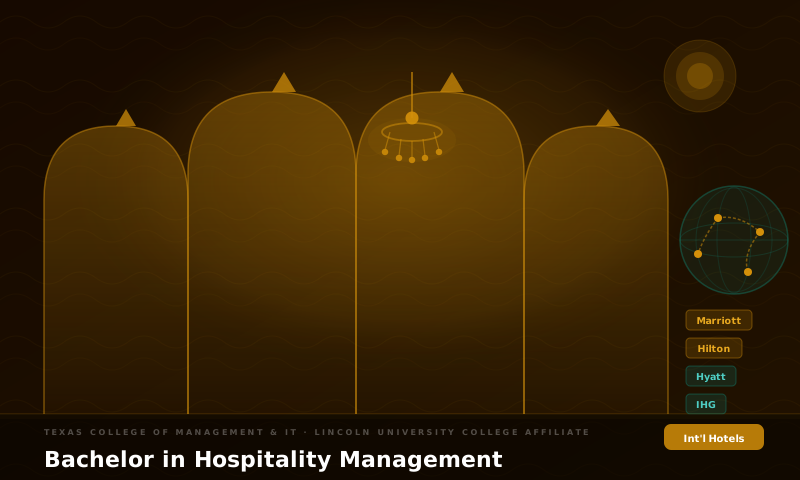
BHM, or Bachelor of Hospitality Management, is a four-year undergraduate program that trains students across hotel operations, food and beverage management, housekeeping, and tourism, typically combined with an international university affiliation and structured internship requirements. At Texas College of Management and IT, the BHM program runs under affiliation with Lincoln University College, Malaysia.
💡 Quick Fact: BHM (Bachelor of Hospitality Management) is a four-year hospitality degree combining hotel operations training with tourism management coursework, and programs affiliated with international universities add a globally recognized credential to the local qualification.
What Makes a BHM Graduate Hireable
Employability in hospitality comes down to a specific combination: practical internship hours, language and communication skills, and any additional certifications earned during the program. Hotels and resorts in Nepal’s competitive tourism markets tend to prioritize candidates who can demonstrate real guest-handling experience over those who can only recite service theory from a textbook, a pattern that rewards programs with strong internship pipelines over those with internships as a checkbox exercise.
Communication skills, particularly spoken English and comfort with international guests, matter disproportionately in hospitality compared to many other degree fields. A BHM graduate who can confidently handle a front-desk interaction in English, manage a booking system, and stay composed during a busy check-in rush is far more placement-ready than one who has only studied these skills in theory.
Affiliation and Duration
A BHM under a foreign university affiliation generally follows the same four-year structure as locally affiliated programs but adds an internationally recognized credential alongside the local qualification. This matters for students who may want to work abroad in hotel chains or international tourism companies later in their career, since some employers weight international affiliation when comparing candidates.
Tourism & Hospitality — Broader Career Options Beyond Hotels
Hospitality careers extend well beyond hotel front desks into travel and tour operations, airline ground and cabin services, event management, and hospitality consulting, making the field broader than the “hotel management” label suggests. Students searching for a tourism and hospitality college in Nepal are often exploring this wider career map, not just hotel-floor roles.
💡 Quick Fact: Hospitality degree holders in Nepal commonly move into travel and tour operations, airline customer service, event and conference management, and tourism consulting, in addition to traditional hotel operations roles, reflecting the field’s broader career footprint beyond hotels alone.
Travel and tour operation roles involve designing itineraries, managing client logistics, and coordinating with hotels and transport providers, work that draws directly on the tourism management modules covered in most hospitality curricula. Airlines also recruit hospitality graduates for ground handling, customer service, and cabin crew positions, where the same guest-service training used in hotels transfers directly.
Event management has grown into its own specialization within hospitality, covering weddings, conferences, and corporate events, sectors that have expanded steadily alongside Nepal’s growing hospitality infrastructure.
Career Scope in Hospitality in Nepal
Career progression in hospitality typically moves from entry-level operational roles, front desk, food service, or housekeeping supervision, into department management, and eventually into hotel or resort leadership positions, with international placement as an additional track for graduates who build strong English and service credentials. Nepal’s ongoing tourism-sector activity continues to sustain demand for trained hospitality professionals across this pipeline.
💡 Quick Fact: Hospitality careers in Nepal generally follow a three-stage progression, entry-level hotel operations, mid-level department management, and senior hotel or resort leadership, with international placement available as a parallel track for graduates with strong communication skills and internship experience.
Entry-level roles typically involve direct guest contact: front office associate, food and beverage server, or housekeeping team member. These positions build the operational foundation that later management roles depend on, which is part of why internship quality during the degree matters so much for long-term progression.
Mid-career roles shift toward supervision and department management, running a front office team, a food and beverage outlet, or a housekeeping department. At this stage, graduates who combine operational experience with strong communication and basic management training tend to advance faster than those with operational experience alone.
Senior roles, hotel or resort management, area or regional oversight, and corporate hospitality positions, generally require several years of combined operational and supervisory experience. Graduates who actively sought varied internship placements, rather than staying in one department throughout their training, tend to move into supervisory roles faster, since they arrive with a broader operational picture rather than depth in a single function only.
International placement is a realistic option for graduates with strong English skills, relevant certifications, and a degree from a program with recognized affiliation, since international hotel chains and cruise operators actively recruit from hospitality programs across South Asia. This isn’t guaranteed for every graduate, but it is a genuine and commonly pursued track within the field.

Choosing a Hotel Management Institute in Nepal
The right hotel management institute is defined less by its name or ranking and more by four concrete factors: active hotel and industry partnerships for internships, faculty with real hospitality-industry experience, practical training facilities like mock kitchens and front-office labs, and a credible affiliation or accreditation. These are the specifics worth checking before comparing brochures or fee structures.
💡 Quick Fact: The strongest indicators of hotel management institute quality in Nepal are verified hotel-industry internship partnerships, faculty with direct hospitality-sector work experience, on-campus practical labs such as mock front offices and training kitchens, and a recognized university affiliation, rather than marketing claims alone.
Industry partnerships for internships should be checkable, not just claimed. Ask which specific hotels or resorts host students, how many students they place per intake, and whether the arrangement is a standing partnership or a one-off. A program with named, verifiable partner properties is a stronger signal than one that says “internship opportunities available” without specifics.
Faculty background matters more in hospitality than in most fields, since the subject is fundamentally about applied service skills. Instructors who have themselves worked in hotel operations, food and beverage management, or tourism bring practical judgment that’s hard to replicate from textbook knowledge alone.
Practical facilities, mock front-office counters, training kitchens, and simulated guest-service setups, let students rehearse real scenarios before their internship even begins. A program without these labs is relying entirely on the internship stretch to teach practical skills, which is a heavier lift for students with no prior exposure.
Affiliation and accreditation round out the picture. Texas College of Management and IT offers a BHM program with a foreign university affiliation, combining an internationally recognized qualification with practical training delivered locally in Kathmandu, and is one option worth evaluating against these criteria alongside others you’re considering.
FAQ
Do I need a science or management background to study hotel management?
No. Hospitality and hotel management programs in Nepal accept students from science, management, commerce, and humanities streams. Institutes generally prioritize communication skills and service orientation over a specific +2 subject background, unlike more stream-restricted fields such as engineering.
What’s the difference between hotel management and tourism management?
Hotel management focuses on operations within a single property: front office, food and beverage, and housekeeping. Tourism management takes a wider view, covering destination planning, travel packages, and the broader travel industry. Most BHM programs teach both, with hotel operations as the primary emphasis.
How much practical/internship training does a BHM include?
BHM programs are built around substantial internship components alongside classroom study, typically placing students in real hotel or resort environments for structured, supervised training. Exact hours vary by institute, so ask directly about required internship duration and named partner properties before enrolling.
Is hospitality a good career choice in Nepal right now?
Hospitality remains a legitimate and structurally in-demand career path in Nepal, supported by ongoing tourism-sector activity and a career pipeline that runs from entry-level hotel roles through management to international placement. It rewards students who commit to strong internships and communication skills.
Is a foreign-affiliated BHM better recognized than a local one?
A foreign-affiliated BHM adds an internationally recognized credential alongside the local qualification, which can help with international placement or further study abroad. Both local and foreign-affiliated BHM degrees can lead to strong hospitality careers; affiliation is one factor among several, not the only one.
Ready to Explore Hospitality as a Career?
Hospitality offers something few other bachelor’s degrees after +2 can match: a genuinely cross-stream entry point into a career built on real, hands-on training rather than lecture halls alone. Whether your interest is hotel operations, tourism planning, events, or airlines, the degree and internship path you choose now will shape how confidently you walk into that first job.
If you’d like to see how this looks in practice, explore the BHM program at Texas College of Management and IT, carrying a foreign university affiliation and built around practical training in Kathmandu.